

“We had tried for nearly 6 months to do this on our own, that took only a few days of setup and effort working with Agent37. We'll finally be able to offer high-quality agents at scale, on a timeline that we thought was going to be way too aggressive. We've now dedicated our agent tooling and infrastructure entirely on top of Agent37.”Verified review on Trustpilot, August 2026
The problem
Boon writes grant applications for nonprofits. A client sends over a folder of their own documents. Boon turns it into a funding plan past 30 pages, then a 20-step sourcing run that comes back with roughly 50 grant opportunities and 300 aligned funders, ranked and dated.
That part already worked. The skills were written, the research was good. What Boon did not have was anything to run it. Every brief and every grant started with a person opening Claude Code and typing.
“We have a lot on our waitlist that are wanting to do it, but we have an internal bandwidth problem. We just can’t serve the demand.”
What they tried
Render, which worked. Wes had a Hermes agent up around the clock and answering in Slack. Getting there cost him a provisioning pipeline he wrote by hand against the Render CLI, and it only ever covered one client at a time.
“I had to build a whole process to spin up a render and use the render CLI, and it was not fun.”
Render is a good host. That is exactly the problem. A host hands you a machine, and everything between a machine and a working agent for one specific client was still theirs to build: the provisioning, the copy of the skills, credentials scoped to that client and no other, the schedule, the teardown.
What they run now
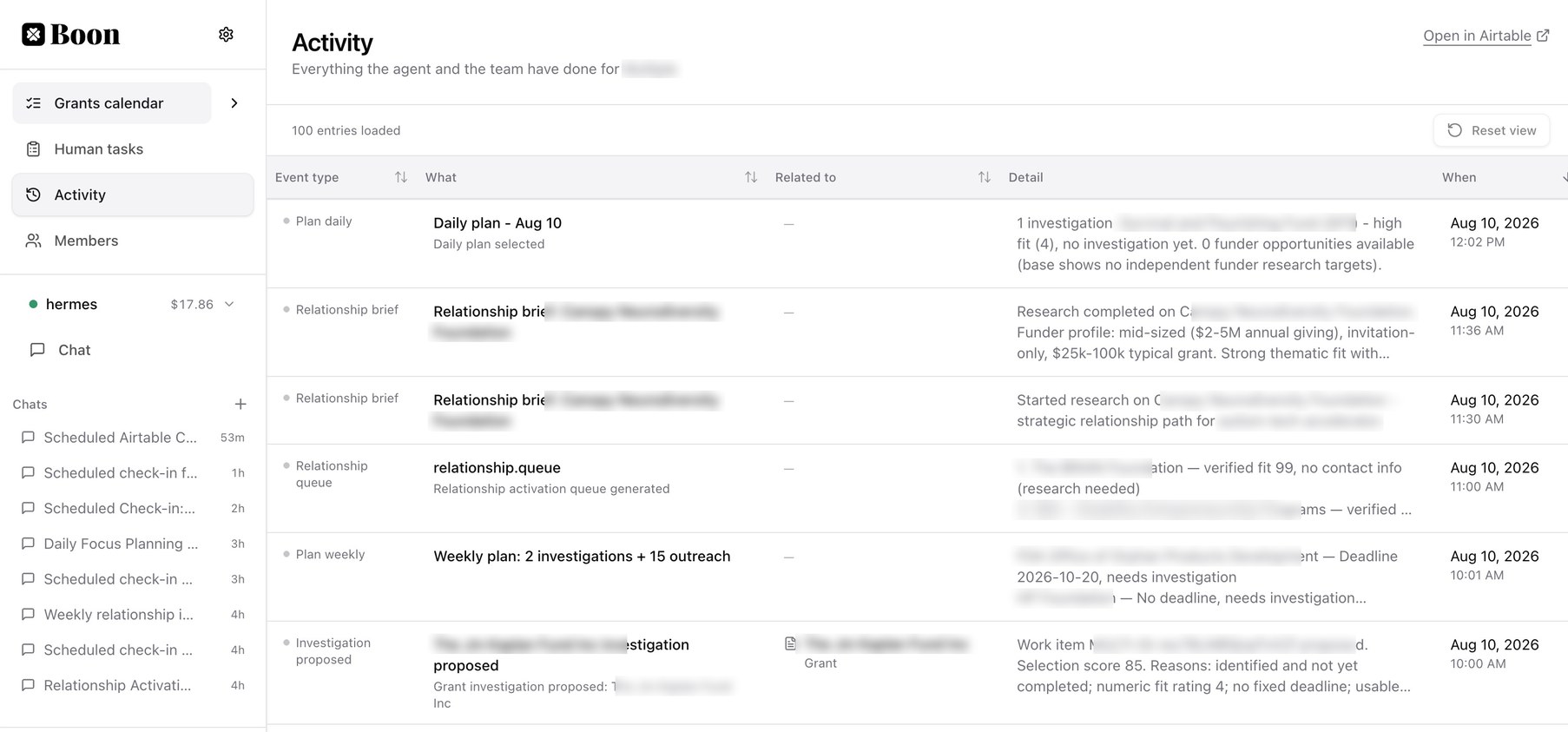
One client is one API call. It comes back as an always-on Hermes agent that holds that client’s data, that client’s identity, and a hard ceiling on what it can spend. It answers on an OpenAI-compatible endpoint from the moment it boots, so integrating it was a base URL, the same as pointing at any model API. What Boon skipped is everything behind that URL: the chat backend, the streaming, the place a client’s history lives. Boon publishes a skill once and every agent picks it up, pushed in from Boon’s own server, so no git credential ever sits inside a container.
Two cron jobs in Boon’s app drive the fleet. A heartbeat wakes each client’s agent on its own cadence, hourly to daily, and a second one runs Boon’s recurring workflows against every agent that is up and posts the result into Slack, failures included. No schedule lives inside an instance, so cadence is a setting per client rather than a redeploy.
An operator still approves what reaches the client. They just stopped being what starts the work.
The outcome
- 3 days to a per-client fleet: 6 months of building the hosting themselves, replaced. The provisioning pipeline they had written by hand was deleted.
- 17 times cheaper per agent: The same 2 vCPU and 4 GB shape costs $85 a month on their old host. It is $4.94 here, always on, per client.
- Skills ship once: Boon publishes from one repo and every client's Hermes agent picks it up, with no git credential inside any container.
Boon kept the part that makes them money, the research and the writing. We took the fleet.