
Table of Contents
- Why People Pay for Skills (It's Not the Code)
- What Are Claude Agent Skills?
- Three Ways to Monetize Skills (Only One Scales)
- Why Monetizing Skills Is Hard Right Now
- How to Build a Skill Worth Selling
- Pick a Job That Already Has a Budget
- Define Your Unit of Value
- Decide Your Moat (How You Stay Paid)
- How to Build a Production-Ready Skill
- How to Write a SKILL.md Claude Will Actually Use
- Keep Context Cheap with Progressive Disclosure
- Lock Down Tools (Security Is Non-Negotiable)
- Version Like You Mean It
- Where to Sell Claude Skills (Distribution Channels)
- How Agent37 Solves Skill Monetization
- Understanding the Claude API for Skills
- Key Claude API Facts (As of Late 2025)
- How to Price Your Skills Without Going Broke
- Claude Token Pricing You Can Plan Around
- A Simple Cost Model You Can Actually Use
- Pricing Strategies That Work for Skill Products
- What About Claude's Consumer Pricing?
- Security and Trust (Your Attack Surface Just Got Real)
- Minimum Viable Security Checklist
- How to Sell Skills in 2026 (Go-to-Market)
- Your Marketing Funnel Should Look Like This
- What to Post That Actually Converts
- 14-Day Launch Plan for Your First Paid Skill
- Days 1-3: Define and Scope
- Days 4-7: Build V1
- Days 8-10: Productize
- Days 11-14: Launch
- Frequently Asked Questions About Monetizing Claude Skills
- Can I monetize a skill without giving away my source code?
- Won't users just copy the outputs?
- How many skills can I bundle together?
- Are skills "free" to use?
- What models should I use for my skill?
- How quickly can I start earning?
- What's the minimum viable security I need?
- Ready to Monetize Your Skills?
- A Strategic Blueprint to Monetize Claude Code Skills
- Prompts Disappear. Skills Persist. Persistence Is the Asset.
- Two Quiet Revenue Models: Skills Behind Services and Internal Licensing
- The behind-the-scenes service
- Internal licensing
- MCP Servers vs Claude Skills: Sell the Procedure, Not the Protocol
- Run the Numbers, Then Ship It Somewhere Always-On
Do not index
Do not index
If you're searching "monetize Claude Code skills," you already know what a skill is. You've probably built one. Maybe several.
What you're actually trying to figure out is this: how do I turn a Claude skill into reliable revenue without shipping my source code or forcing customers to install a bunch of developer tools?
That's exactly what this playbook covers. It's written for people who build AI agents and want to sell them like products, not give them away or tie themselves to hourly consulting forever.
Why People Pay for Skills (It's Not the Code)
First principles: people don't pay for a
SKILL.md file. They pay for an outcome.A monetizable skill is essentially a repeatable workflow that takes messy input (documents, spreadsheets, repos, tickets, URLs) and runs it through a consistent process (your steps, your heuristics, your logic) to produce something decision-ready.
That decision-ready output might be:
→ A contract brief with red flags ranked
→ A compliance report ready for the C-suite
→ A forecast your client can actually trust
→ A prioritized list that saves someone 4 hours of manual work
This is the unit of value. Not the code. Not the clever prompt engineering. The outcome.
When you're thinking about monetizing your AI expertise, you're really thinking about how to package that outcome and make it:
- Discoverable (Claude actually triggers it when relevant)
- Safe (won't blow up data, leak secrets, or run wild)
- Supportable (you can update versions and fix issues)
- Sellable (trial, paywall, retention loop)
What Are Claude Agent Skills?
- A required
SKILL.mdfile with YAML frontmatter (name,description, etc.)
- Optional supporting files (scripts, templates, reference docs)
The key distinction from slash commands: Claude autonomously decides when to use a skill based on your request and the skill's description. Anthropic's documentation calls this "model-invoked" behavior.
Skills can be stored in three places:
• Personal: under
~/.claude/skills/ (just for you)• Project: under
.claude/skills/ (shared via git with your team)• Plugin-bundled: packaged inside Claude Code plugins
And they work across claude.ai, Claude Code, the Claude Agent SDK, and the Claude Developer Platform, according to Anthropic's engineering team.

Three Ways to Monetize Skills (Only One Scales)
When people talk about monetizing skills, they're usually conflating three very different things:
Approach | What It Means | The Problem |
Selling the files | License the folder | Leaks your IP completely. Piracy is trivial. |
Selling hosted access | Users pay for access to a running skill | This is the one you want. |
Selling a service | You run the skill for them | Ties revenue directly to your time. |
Only the hosted access model scales cleanly. Selling files gives away your IP the moment someone downloads them. Selling services puts you back on the hourly treadmill you were trying to escape.
Why Monetizing Skills Is Hard Right Now
Skills are new and powerful, but the default distribution path is still painfully developer-centric:
- Share a repo or a zip file
- Customer installs Claude Code or the plugin marketplace
- Customer configures permissions and environment variables
- Customer pays you... somehow?
This is why "selling the file" has become the common workaround, even though it's objectively a terrible business model.
Skills are quickly becoming a core layer in the agent ecosystem. TechRadar reports that Anthropic has been pushing skills as reusable modules, and adoption is accelerating across developer workflows.
This is precisely the problem Agent37 was built to solve. Unlike traditional no-code AI platforms, Agent37 is specifically designed for skill monetization.
But first, what makes a skill worth selling in the first place?
How to Build a Skill Worth Selling
Building a skill is easy. Building one that people will pay for requires a different kind of thinking. Understanding what makes a digital product valuable is the first step.
Pick a Job That Already Has a Budget
The best skill products replace something expensive:
→ A contractor someone is already paying
→ A recurring tool subscription they're locked into
→ A painful internal process that eats hours every week
→ A high-risk mistake in compliance, finance, legal, or security
If the user's alternative is "I'll just do it manually," your pricing is capped at whatever they value their own time at (often: not much).
But if the alternative is "I'd pay $2,000/month for a junior analyst to do this," your pricing opens up dramatically.
Define Your Unit of Value
A skill product needs a clean unit that customers understand:
Unit Type | Example |
Per report | 10 contract briefs / month |
Per workflow | 50 tickets triaged |
Per seat | 1 compliance manager |
Per artifact | 20 pitch decks generated |
Pricing that isn't tied to a unit becomes vibes. And vibes don't renew. For more on structuring recurring revenue, see our guide on subscription business model examples.
Decide Your Moat (How You Stay Paid)
You can't stop someone from copying your ideas. You can stop them from copying your value.
Real moats for skill products:
① Proprietary templates and heuristics built from actual client work
② Curated datasets (benchmarks, rubrics, checklists) that took months to compile
③ Tool integrations (MCP servers, APIs) that are non-trivial to replicate
④ Execution environment with safe sandbox and secrets management
⑤ Continuous updates and eval-driven improvement based on real usage

How to Build a Production-Ready Skill
There's a massive difference between a skill that works on your machine and a skill that's ready for paying customers. Whether you're building an AI chatbot or a specialized workflow automation, these principles apply.

How to Write a SKILL.md Claude Will Actually Use
Claude decides whether to activate a skill primarily based on the
name and especially the description field. The documentation is explicit: the description is the discovery engine.Here's a minimum viable template:
---
name: contract-brief
description: Summarize a contract into a 1-page risk brief with clause-by-clause notes, red flags, and suggested edits. Use when a user provides a contract (PDF/DOC/text) and asks for review, risks, or negotiation language.
---
# Contract Brief
## Instructions
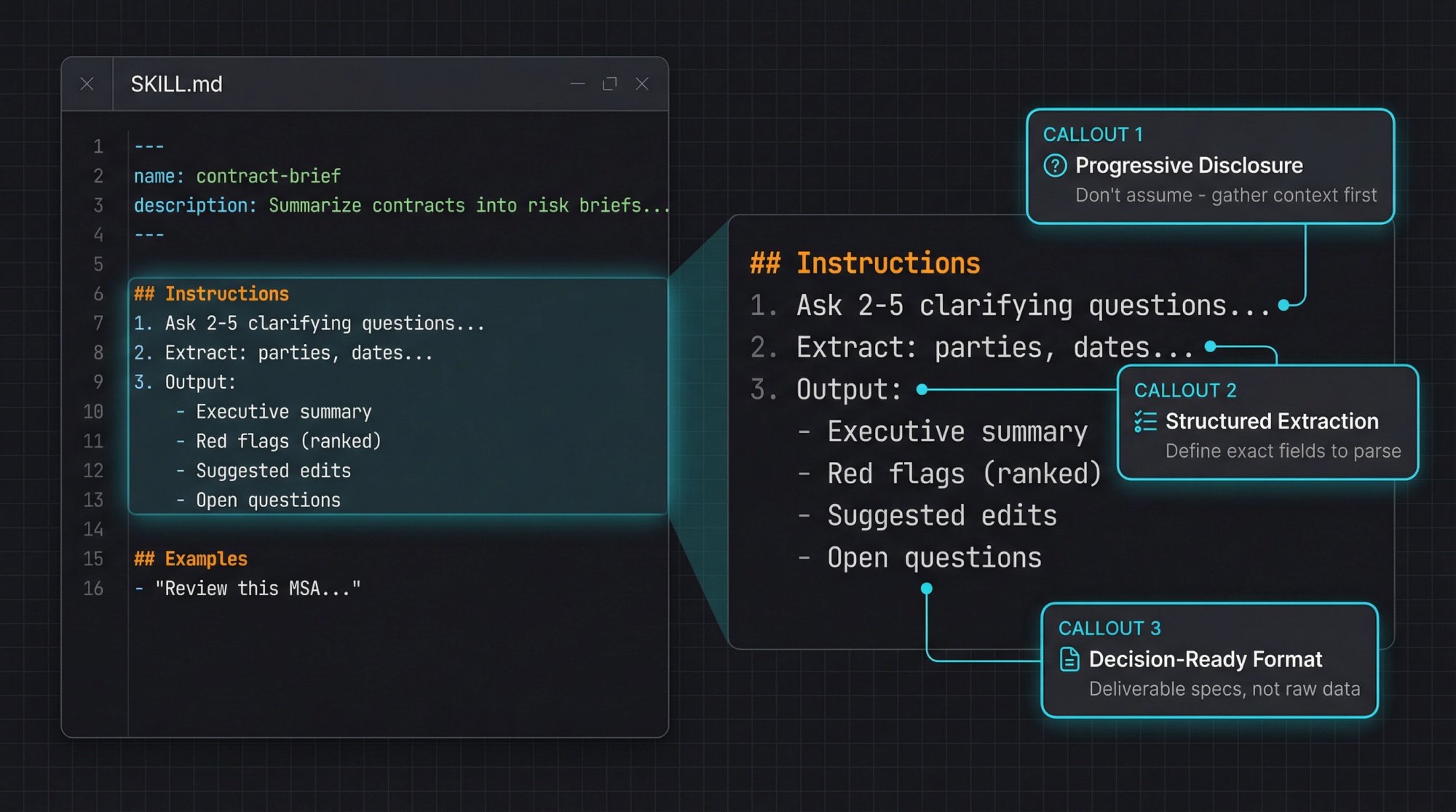
1. Ask 2-5 clarifying questions if key context is missing (jurisdiction, counterparty, deal size, risk tolerance).
2. Extract: parties, dates, term, renewal, payment, termination, liability, indemnity, IP, confidentiality, data, governing law.
3. Output:
- Executive summary (10 bullets max)
- Red flags (ranked)
- Suggested edits (copy/paste clause language)
- Open questions for counsel
## Examples
- "Review this MSA and tell me what to push back on"
- "Summarize this contract for my CEO"The frontmatter has strict constraints (lowercase + hyphens for name, length limits). Get this wrong and Claude simply won't find your skill.
Keep Context Cheap with Progressive Disclosure
Skills can include extra files (references, templates, scripts). Claude reads them only when needed, which prevents you from dumping your entire knowledge base into the context window every time.
A solid folder structure:
my-skill/
├── SKILL.md
├── reference.md
├── templates/
│   ├── output.md
│   └── checklist.md
└── scripts/
    └── scorer.py
Anthropic's docs confirm this "read when needed" behavior, which keeps your costs down and your responses fast.
Lock Down Tools (Security Is Non-Negotiable)
Skills can include code and steer an agent into taking actions. That's powerful. It's also dangerous.
Anthropic explicitly warns that malicious skills can introduce vulnerabilities. Their recommendation: install only from trusted sources, audit bundled files, and watch for risky network behavior.
In Claude Code, you can restrict tool access using
allowed-tools in the frontmatter:---
name: safe-file-reader
description: Read and search files without modifying anything.
allowed-tools: Read, Grep, Glob
---This isn't hypothetical. Security researchers have demonstrated tricking Claude plugins into deploying actual ransomware. Don't treat security as an afterthought.
Version Like You Mean It
Skills are software. Paying customers need stability.
Your product policy should be:
- Patch releases: Fix bugs, no behavior surprise
- Minor releases: New capability, backward compatible
- Major releases: Behavior changes, opt-in
Where to Sell Claude Skills (Distribution Channels)
You have four realistic options for getting your skill into customers' hands. Here's what each one actually means:

Channel | How It Works | Who It's For | Can You Sell? |
License the folder | Share a zip/repo | Templates, learning products, internal teams | Sort of (leaks IP) |
Project skills via Git | .claude/skills/ in a repo | Internal org workflows | No (team-only) |
Plugin marketplace | Add repo as plugin source | Open distribution, free products | No (no payments) |
Hosted runtime | Customer opens a link, tries it, pays | Real products | Yes |
The GitHub anthropics/skills repo shows how to add a repository as a plugin marketplace, but there's no built-in payment or access control.
If your distribution requires installing a CLI, you're leaving money on the table.
How Agent37 Solves Skill Monetization
If your goal is "Gumroad for Claude skills," you need three boring things solved:
① Runtime: So customers can use your skill without local setup
② Payments + Access Control: Trial, paywall, subscription
③ Iteration Tooling: So you can improve based on real usage data
Agent37 is purpose-built for the runtime piece, and its white-label setup keeps billing and access in your hands. Here's how it works:
Feature | What You Get |
Browser workspace | Web terminal, file browser, and live desktop |
Scheduled jobs | Recurring runs without keeping a machine awake |
White-label by default | Your customers never see Agent37; you bill them directly |
App integrations | 1,000+ apps via Composio (Gmail, WhatsApp, Slack, GitHub) |
That last one is critical. Most no-code agent builders make you wire every integration yourself. On Agent37 they ship with the instance.
What can skills running on Agent37 actually do?
They execute in a sandbox environment with access to:
- The internet (API calls, web scraping)
- Bash commands and Python scripts
- File processing (CSVs, PDFs, and more)
- Document generation
Understanding the Claude API for Skills
Even if you plan to sell via a hosted platform like Agent37, understanding the native API model matters. It shapes your cost structure, security boundaries, and how many skills you can bundle. If you're new to building AI assistants, this context is essential.
Key Claude API Facts (As of Late 2025)
Skills integrate through the Messages API using a code execution tool. You specify skills via the
container parameter.- You can include up to 8 skills per request
- Enable via beta headers:
code-execution-2025-08-25,skills-2025-10-02, andfiles-api-2025-04-14for file handling
There are two sources of skills in the API:
Source | Type | Example IDs |
Anthropic skills (prebuilt) | anthropic | pptx, xlsx, docx, pdf |
Custom skills (yours) | custom | skill_01..., private to your workspace |

How to Price Your Skills Without Going Broke
This is where most creators mess up. They price on "how cool it is" instead of:
→ Value delivered to the customer
→ Cost to serve (your token bill)
→ Worst-case usage patterns

Claude Token Pricing You Can Plan Around
Claude Sonnet 4.5
- $3 per million input tokens
- $15 per million output tokens
- $5 per million input tokens
- $25 per million output tokens
Anthropic also highlights significant cost levers:
- Prompt caching can cut costs up to 90%
- Batch processing can cut costs 50%
A Simple Cost Model You Can Actually Use
Define your variables:
t_in= average input tokens per user interaction
t_out= average output tokens per interaction
p_in,p_out= price per million tokens
n= interactions per user per month
Then:
Monthly cost per user = n x ((t_in/1,000,000) x p_in + (t_out/1,000,000) x p_out)
Anthropic's pricing docs include a worked example (customer support agent scenario) using Sonnet 4.5.
Pricing Strategies That Work for Skill Products
① Subscription with Guardrails (Best Default)
- $X/month
- Includes Y "heavy" runs or Z messages
- Soft-limit: degrade to lighter model or shorter outputs after threshold
This works because buyers understand it, and you can plan your margins.
② Usage-Based Credits (Best for Spiky Workloads)
Sell packs:
- 100 credits = 100 runs (or 10 heavy runs)
- Good for agencies or analysts who don't want another monthly subscription
③ Enterprise License (Best When Skills Touch Sensitive Data)
Sell:
- Annual contract
- Dedicated workspace / isolation
- Audit logs
- Custom integrations
What About Claude's Consumer Pricing?
For reference (not as your pricing model), claude.ai lists a Pro plan at $17/month with annual discount ($200 billed up front). The Verge reports on Max plan tiers at $100/month and $200/month.
Don't copy these. Use them as a baseline for "what the market already accepts for general-purpose Claude." Your skill should price on specific value.
Security and Trust (Your Attack Surface Just Got Real)
Once money is involved, two things happen fast:
- Users start feeding your skill sensitive information
- Attackers start probing for vulnerabilities
Anthropic's engineering guidance is blunt: skills can add code and instructions, and untrusted skills should be audited for risky behavior and dependencies.
The broader ecosystem has active research documenting security risks. This arXiv paper covers prompt injection and tool misuse in multi-tool environments like MCP.
And on the policy side: if you're building a commercial product on Claude, you need to respect usage policies. WIRED reported on API access being revoked for alleged terms violations.
Translation: your monetization plan must include a security plan.
Minimum Viable Security Checklist
- Restrict tools (or require confirmations for write/delete/network actions)
- Never hardcode secrets in the skill folder
- Sandbox execution (no host filesystem access)
- Log tool calls + outputs (for debugging and audits)
- Rate limit abuse patterns
- Clear user-facing disclaimer about what the skill is and isn't
How to Sell Skills in 2026 (Go-to-Market)
The winning motion right now is demo-first, not readme-first.
Nobody wants to read your documentation and then decide to buy. They want to try it and be impressed.

Your Marketing Funnel Should Look Like This
① A shareable demo (1-click, no setup required)
② A before/after artifact (show the output quality)
③ A tight landing page (who it's for, what it does, examples, pricing)
④ A trial (free runs, limited)
⑤ A paywall
⑥ A retention loop (saved outputs, integrations, notifications, templates)
This is why hosted runtimes matter so much. They turn "cool repo" into "product." For small businesses looking to use AI, this accessibility is a big deal.
What to Post That Actually Converts
Skip the hype. Show the work:
→ "Here's the exact messy input, here's the output"
→ "Here's how much time this saved in a real workflow"
→ "Here's the rubric/checklist the skill follows"
→ "Here's a failure mode we discovered + how we fixed it"
Skills are especially powerful when they standardize "how work gets done." The Verge notes that this is exactly what Anthropic pitches: consistent, reusable modules for specialized tasks.
14-Day Launch Plan for Your First Paid Skill
Days 1-3: Define and Scope
- Pick one job with a budget
- Define your unit of value
- Pick your model (Sonnet for most use cases, Opus when correctness is worth the premium)
Days 4-7: Build V1
- Write your
SKILL.mdwith real examples
- Add templates and scripts
- Add tool restrictions
- Test on 10 real inputs (not toy examples)
Days 8-10: Productize
- Create 3 "golden outputs" (case studies)
- Write a short landing page with pricing
- Add trial limits and abuse protection
Days 11-14: Launch
- Ship the demo link
- Post 3 case studies
- Onboard 5 design partners (free or heavily discounted)
- Turn their feedback into v1.1

For coaches and consultants looking to productize expertise, our guide on how to create a coaching program provides additional frameworks for structuring your offering.
Frequently Asked Questions About Monetizing Claude Skills

Can I monetize a skill without giving away my source code?
Yes. But only if you sell access to a running instance (hosted). Selling the folder is functionally equivalent to selling your source code. Anyone who downloads it can copy, modify, and redistribute it.
This is why platforms like Agent37 exist: you upload your skill, we run it, customers access it through a link. Your code stays protected.
Won't users just copy the outputs?
They can copy individual outputs. That's fine. You're selling:
→ Speed: instant results vs. hours of manual work
→ Consistency: same quality every time
→ Access to your rubric and workflow: the logic they can't replicate
→ Tool integration: APIs and data sources baked in
→ Updates: continuous improvement as you learn from usage
How many skills can I bundle together?
According to Anthropic's API documentation, you can include up to 8 skills per request via the
container.skills parameter.Are skills "free" to use?
Skills are included in paid Claude plans, and API usage follows standard token pricing. You pay for tokens, not separately "for skills."
What models should I use for my skill?
For most use cases, Claude Sonnet 4.5 offers the best balance of capability and cost. If your skill handles high-stakes decisions where mistakes are expensive (legal, financial, compliance), consider Claude Opus 4.5 for its stronger reasoning.
How quickly can I start earning?
With a hosted platform like Agent37, you could go from "finished skill" to "live product" in a single afternoon. No infrastructure setup. Host the skill, set your own pricing with customers, and share access.
What's the minimum viable security I need?
At minimum: restricted tools, no hardcoded secrets, sandboxed execution, logging, rate limiting, and a clear disclaimer. If you're handling sensitive data, add dedicated workspaces, audit logs, and consider SOC 2 compliance requirements.
Ready to Monetize Your Skills?
The window is open right now. Skills are becoming the standard way to package reusable AI workflows, but most creators are still stuck in the "share a zip file" era.
If you've built something valuable, don't give it away for free or tie yourself to hourly consulting. Turn it into a product.

Agent37 handles the infrastructure so you can focus on building great skills. Host your skill, sell access under your own brand, and keep everything you charge; hosting starts at $3.99/mo.

A Strategic Blueprint to Monetize Claude Code Skills
Everything above covers the mechanics: build, price, distribute, secure. This section is the strategy layer. Zoom out before you zoom in, because the fastest way to waste a quarter is to productize the wrong skill.
The profitable way to monetize Claude Code skills starts with a filter, not a feature list. If a business already spends money solving a problem manually, it will pay for a skill that solves it better. If nobody budgets for the problem today, your skill is a curiosity, not a product.
In 2026, buyers are done experimenting with AI. They are operationalizing it. They expect skills that are reliable, safe to deploy internally, easy to integrate, and capable of real reasoning over long context. The categories where budgets already exist:
- Customer support automation and ticket triage
- Internal knowledge search and summarization
- Sales and lead qualification assistants
- Compliance and policy analysis
- Reporting, analytics, and decision support
- Content workflows with tight quality controls
Once you have the category, run the blueprint in order:
- Identify one problem for one specific audience. Narrow beats broad every time.
- Choose the monetization model up front: subscription, usage-based credits, internal licensing, or consulting plus deployment.
- Productize before you sell. Define inputs and outputs, standardize the workflow, and cut custom work to near zero.
- Price on value delivered, never on time spent. Factor in token costs, infrastructure, and the updates you will owe paying customers.
- Distribute where your buyer already looks: SEO content, founder-led LinkedIn, niche communities and newsletters, direct outreach, and partnerships.
The positioning shift matters more than any single tactic. "I build AI solutions" sells nothing. "This skill cuts internal support tickets by a third" sells itself. One clearly defined skill for one audience consistently outperforms generic positioning. Focus is the strategy.
Prompts Disappear. Skills Persist. Persistence Is the Asset.
Here is the cleanest way to explain skill value to a buyer who still thinks in prompts.
A prompt exists in a single moment. When the conversation ends, the logic disappears. A skill persists across sessions. It carries your decision rules, structure, tone, and constraints forward automatically, no matter who triggers it or how often it runs.
That persistence is the entire economic argument. Companies do not want outputs that vary depending on who ran the tool or how experienced they were. A well-built skill reduces variability, lowers supervision costs, and shortens turnaround time. Reuse is what turns knowledge into something sellable, and it is why serious teams now treat skills as digital assets, not features.
The non-code angle follows directly from this. A skill is a folder of markdown instructions, so you do not need to be a developer to build one worth paying for. A hiring rubric, an audit checklist, an editorial review process: if you can write your expertise down as steps, you can package it. Our guide to building Claude skills that sell walks through that process from scratch.
Before you charge for any skill, apply a simple readiness test:
- The scope is clear and limited, and the skill does one job
- Output stays stable even when inputs vary
- It runs reliably without daily prompt surgery or babysitting
If a skill only works when you supervise it closely, it is not ready. Monetization depends on trust, and trust depends on consistency.
The graduation step is moving from individual skills to skill systems. One skill handles intake. Another performs analysis. Another formats output. Another applies review rules. From the buyer's perspective a system is far more valuable than an isolated function, because they are not buying a tool. They are buying a process that already works. Systems are easier to position, easier to defend, and much harder to replace.
Two Quiet Revenue Models: Skills Behind Services and Internal Licensing
Earlier, this playbook said hosted access is the only model that scales cleanly. That is still true. But two models from the field generate real revenue right now, and both can fund the product you eventually host.
The behind-the-scenes service
Many of the highest earners in 2026 do not sell skills directly at all. The skill operates quietly behind a service. Clients never interact with it. They only see the result: reports that arrive on time, analysis that follows the same structure every week, quality that does not fluctuate with workload.
In this model the skill is your margin, not your product. One person delivers what previously required a team. Charge a setup fee, a monthly retainer, and optimization contracts, which makes this the friendliest model for early-stage revenue. The trade-off is that income stays tied to clients, but nothing stops you from productizing the same skill later, once it has proven itself on real work.
Internal licensing
Organizations have grown uncomfortable with unstructured AI usage across teams. They want guardrails, consistency, and systems that behave according to internal standards. A licensed skill delivers exactly that: it can standardize onboarding documentation, internal reporting, customer communications, or compliance checks across every department.
Here the skill is encoded expertise. It replaces training, reduces mistakes, and makes AI behave the same way for everyone. You are selling operational stability, and stability commands a premium. Enterprise agreements and white-label deployments both live in this lane.
Whichever model you pick, price on replacement value: what the skill removes (hours, risk, headcount), not what it adds.
MCP Servers vs Claude Skills: Sell the Procedure, Not the Protocol
A lot of builders confuse MCP servers with skills, and that confusion leads to months of work monetizing the wrong layer.
MCP (Model Context Protocol) is the open standard for connecting AI applications to external systems. Think of it as USB-C for AI apps: clients connect to tools, data sources, and workflows through one consistent protocol, built on three primitives (tools, resources, prompts) and two transports (stdio for local servers, streamable HTTP for remote ones, with OAuth support). In December 2025, Anthropic donated MCP to the Linux Foundation's new Agentic AI Foundation, alongside an official community registry for discovering servers, and AWS Marketplace opened an "AI Agents and Tools" category that includes MCP servers.
Here is what that means for your revenue: discovery is getting standardized, billing is not. The registry helps people find your server. It does not solve trials, access control, refunds, abuse prevention, versioning policy, or enterprise procurement. MCP standardizes how tools connect. It says nothing about how you get paid.
The distinction that should decide your product:
- An MCP server is a capability: which tools and data can be touched
- A skill is a procedure: how the work actually gets done
- A bundle of both is an outcome: what the customer is really paying for
Selling raw MCP access as tool-as-a-service works when your server wraps a paid API or mediates sensitive enterprise workflows with SLAs and audit logs. Marketplace pricing has already set buyer expectations: free hobby tiers with around 50 included calls, overage at fractions of a cent per call, and pro tiers around $20 per user per month. Remote servers also need real authentication (OAuth or API keys) before you charge anyone anything.
The strategic question is simple. If your buyer is a developer, registries and marketplaces help. If your buyer is a business user, sending a link they can try beats every marketplace listing. And if you want durable revenue, the endgame is usually the bundle: your skill, your tools, and a clearly defined outcome delivered every month.
Run the Numbers, Then Ship It Somewhere Always-On
One worked example, because most creators price first and calculate later.
Say your average interaction uses 8,000 input tokens and 2,000 output tokens, and an average user runs 100 interactions a month.
- On Claude Sonnet 4.5 pricing: 100 x (0.024 + 0.03) = $5.40 per user per month
- On Claude Opus 4.5 pricing, the same usage costs about $9.00 per user per month
That gap is the difference between a $29 per month product that prints money and a $29 per month product that quietly burns cash the more users love it. Do this math before you set a price, not after your first API invoice.
The same monetization logic extends past Claude Code. Free agent frameworks like OpenClaw and the Hermes agent run skills of their own, and the honest cost answer never changes: the agent is free, you pay for model API usage plus somewhere always-on to run it. If that is your stack, our guide on how to monetize OpenClaw skills applies the same playbook.
"Somewhere always-on" is the part most creators underestimate, and it is exactly what Agent37 handles. Managed hosting runs an OpenClaw or Hermes agent instance for you from $4 a month, managed entirely from the browser with a task board, a full web terminal, and scheduled jobs. Building the API side of a skill product instead? Agent37 Cloud provisions an always-on agent instance behind one API, white-label by default, so your customers never see Agent37 at all.
Honest caveat: there is no free tier on managed hosting. The cheapest way in is about $4 a month, and new Cloud workspaces get a $1 starter credit to test with, no card required.
You built the skill. The window is open and the infrastructure is solved. Always-on, from $4/mo, deploys in one click: start at https://agent37.com/cloud, or grab a hosted agent at https://agent37.com.